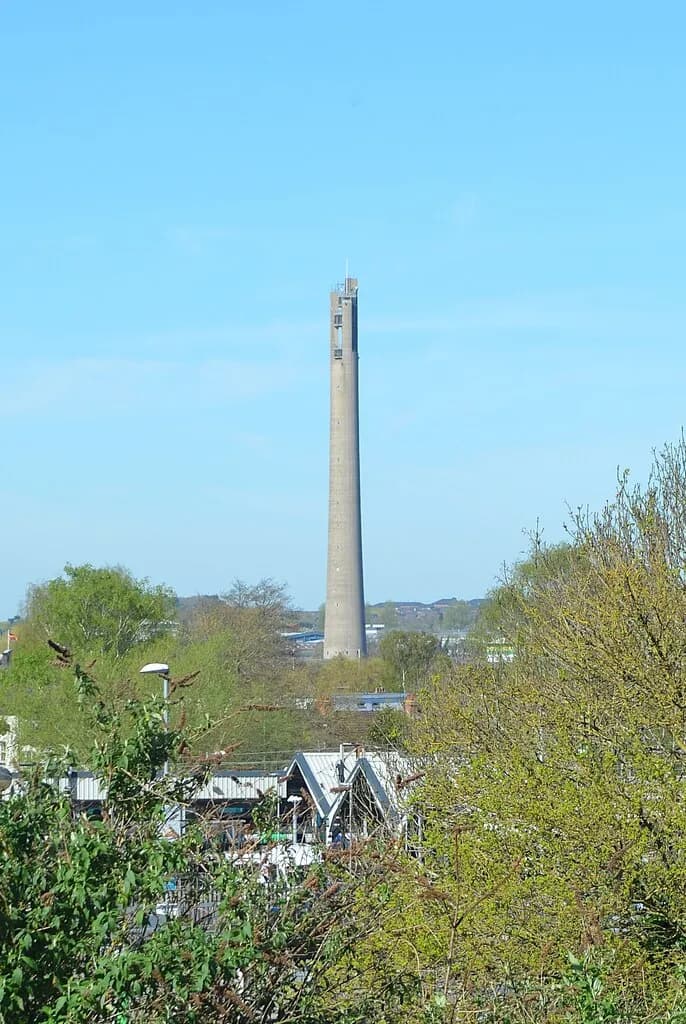
Standing 127.5 metres tall in St James End, the National Lift Tower dominates the Northampton skyline as the country's only dedicated lift-testing facility. Built in the early 1980s for the Express Lift Company, this Grade II listed concrete cylinder has evolved from an industrial testing ground into a multi-purpose research centre, abseiling venue, and unlikely local landmark affectionately dubbed the "Northampton Lighthouse."
From Express Lifts to National Landmark
The Express Lift Company commissioned the tower in 1978 as a purpose-built facility for testing lifts at height. Construction commenced in 1980, and the building officially opened on 12 November 1982 following a royal visit by Queen Elizabeth II. Architect Maurice Walton of Stimpson Walton Bond designed the structure with a distinctive parabolic profile; its diameter tapers from 14.6 metres at the base to 8.5 metres at the top. The original concept imagined six lift shafts "bunched together like a handful of pencils of differing heights," though the final design consolidated the facility into a single tower containing multiple shafts alongside stair access.
The tower's exterior features small, obround-shaped windows that mirror the design motif found on Express Lift Company's control panels. Standing taller than St Paul's Cathedral in London, the structure quickly became one of Northamptonshire's most recognisable landmarks. On 30 October 1997, it received Grade II listed status, making it at that time the youngest listed building in the United Kingdom.
The Terry Wogan Connection
The tower's enduring nickname, the "Northampton Lighthouse," owes its origins to broadcaster Terry Wogan. During his BBC Radio 2 programme, Wogan remorselessly lampooned the structure, joking that the Government had commissioned it in preparation for Northampton's transformation into a coastal town as east coast erosion progressed. His listeners enthusiastically joined the jest, sending hundreds of letters and emails. The moniker stuck, and locals now embrace the tower as an emblem of Northampton's distinctive character.
Local residents often describe the tower as a navigational beacon. Many report knowing they are "nearly home" when spotting the tower's silhouette from the M1 motorway or from Arbury Hill, the highest point in Northamptonshire. The structure's rapid construction produced a memorable local anecdote: built during the factory's summer holiday fortnight, one employee returned from leave to see lights floating in the night sky and telephoned police to report flying saucers.
Testing, Abseiling, and Adaptive Reuse
Originally, the British Standards Institution used one shaft for type testing lift safety components under BS 5655 and BS EN81 standards. When Express Lifts closed its Northampton factory in 1999, the tower and surrounding land were sold to Wilcon Homes for housing development. The tower itself faced an uncertain future until private investment secured its survival.
Following renovation completed in July 2010, the facility reopened for business in October 2009 under its current name, the National Lift Tower. The building now serves multiple functions: lift research and development, drainage testing (as of 2015, it operated as the world's tallest drainage-testing facility), wind turbine access training, drop testing, and sharp edge testing. Abseiling events commenced in May 2011, with permanent approval for up to 24 abseiling events annually granted in September 2014. By May 2012, tower abseils had raised more than £140,000 for charitable causes.
Current Status
The National Lift Tower remains privately owned, operated under the trading name Andrew Horner. The facility continues to serve the lift industry while accommodating film and television productions. The tower has appeared in the 1993 Channel 4 documentary series "The Secret Life of Machines," and featured in Alan Moore's novel "Jerusalem." In June 2021, the structure briefly housed a transmitter for community radio station Revolution Radio on 96.1 FM, though the equipment was subsequently removed.
Plans for a visitor centre with a 100-seater auditorium and café were rejected by Northampton Borough Council in March 2012, with a planning inspector ruling that such development would compromise the structure's elegant profile. The tower therefore remains primarily an industrial and research facility rather than a conventional tourist attraction.
For Northampton residents, the National Lift Tower represents more than concrete and steel. It embodies the town's industrial heritage, its capacity for reinvention, and a community spirit that can transform even the most utilitarian structure into a beloved local icon. Whether viewed from the motorway as a welcome-home signal or descended by rope for charitable fundraising, the tower continues to serve Northampton four decades after its royal opening.