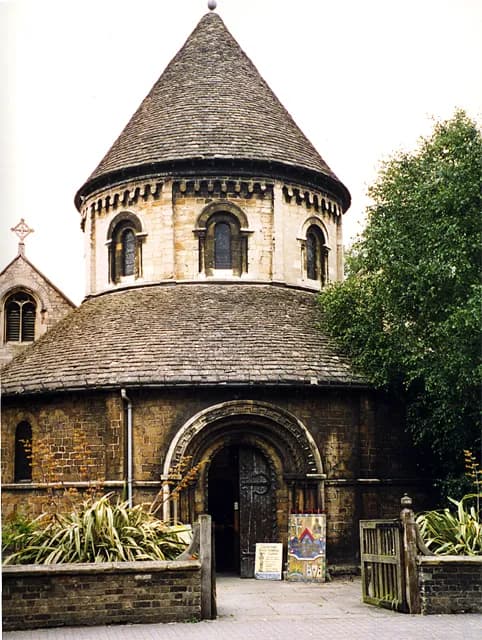
Standing on Sheep Street in Northampton town centre, the Church of the Holy Sepulchre is one of the oldest buildings in the town and one of only four medieval round churches still in use in England. Its unusual circular design dates back to the First Crusade and the ambitions of a Norman earl who sought to recreate a piece of Jerusalem in the East Midlands.
From Jerusalem to Northampton
The church dates from around 1100 AD, making it the first of roughly twenty medieval round churches built in Britain. It is traditionally associated with Simon de Senlis, Earl of Northampton, who joined the First Crusade in 1096 and is believed to have modelled the building on the Church of the Holy Sepulchre in Jerusalem, which features a distinctive circular plan, ambulatory, and columns. The Northampton church was constructed at approximately half the size of its Jerusalem counterpart, funded from the income of Simon's wife, Maud, who was the niece of William the Conqueror.
Architecture of a Round Church
The original Norman design featured a circular nave supported by eight columns and a triforium, with an ambulatory running around the perimeter. Three original Norman windows survive today. The structure was built using soft Northampton ironstone, which has suffered from erosion over the centuries. Additions came over the following decades and centuries: a north aisle was added around 1180, a second north aisle around 1275, and a south aisle in the early fifteenth century, at which point the triforium was replaced by a clerestory and a western tower was added.
Centuries of Change
The church has witnessed nearly a millennium of Northampton's history. Among those buried on the site is Lochlann, Lord of Galloway. The building also carries strong military associations; the Soldiers' Chapel contains memorials to more than 6,000 soldiers from Northamptonshire who died in the two World Wars.
A memorial window to the Rutland Regiment depicts the Battle of Jaffa, showing Richard the Lionheart and Saladin. The church also houses stained glass by Kemp and Morris Brothers, and an 1880 John Stringer organ that is itself Grade II listed.
Victorian Restoration
Extensive restoration work in the Victorian era brought the church much of its present character. The chancel screen, designed by John Oldrid Scott in 1880, remains a notable interior feature. Sources differ over whether the wider restoration scheme was directed by Sir George Gilbert Scott or by Sir Giles Gilbert Scott.
The Church Today
The Holy Sepulchre is a Grade I listed building and has been recognised as an "Icon of Northamptonshire" by its Restoration Trust, which was established in 1982 and has raised £1.3 million over the past three decades. It remains an active place of worship within the Church of England, under the Diocese of Peterborough. As of 2025, it is part of a united benefice with All Saints' Church, Northampton, and regular services are held on Tuesdays at 10:30 am and Sundays at 4:00 pm.